He Jin
The Romance of the Three KingdomsHe Jin’s rise from humble origins to grand administrator brings him into the succession crisis that destabilizes the Han court. As the brother of Empress He and uncle of Prince Bian, he is caught between competing claims to the throne; his attempt to eliminate the eunuchs by summoning troops instead draws Dong Zhuo into the capital and ends with He Jin’s death inside the palace. The episode makes a private alliance of kinship and court power a turning point in the dynasty’s political breakdown.
Identity and Position
He Jin is introduced as a man of humble origins who has become grand administrator. His family ties give him an unusually direct stake in succession: his sister is Empress He, and her son, Prince Bian, is a candidate for the throne. The crisis sharpens when Emperor Ling becomes terminally ill. The court must choose between Prince Bian and Prince Xie, the son of the second consort, who has been raised by Emperor Ling’s mother, Empress Dong.
The succession dispute is not simply a question of inheritance. The eunuchs have long exerted power at court, and the prospect that they might secure the throne for Prince Xie makes the succession an immediate contest over who controls the imperial government. He Jin’s position as both senior official and close royal relative leaves him at the point where those rival interests converge.
The Succession Crisis
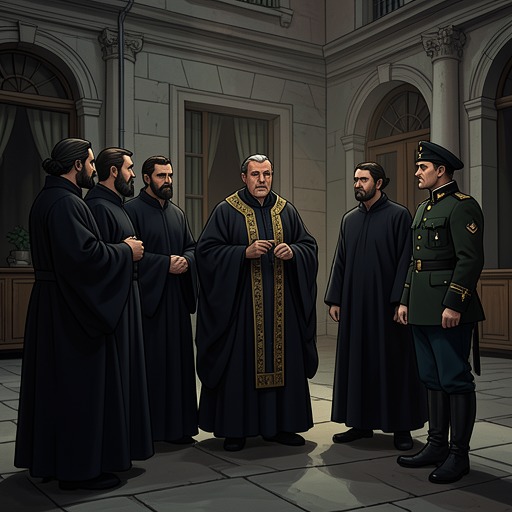
At a meeting of the Council, Cao Cao speaks against the eunuchs’ control of the court and urges that they be eliminated, while warning that any plan must be kept secret because the eunuchs could retaliate against their opponents and families. Before He Jin can respond, news arrives that Emperor Ling has died. The messenger adds that the eunuchs intend to conceal the death until they can arrange the succession for Prince Xie.
Cao Cao immediately proposes Prince Bian as heir, and Yuan Shao, who commands the capital’s troops, joins him. The two men install Prince Bian before the dead emperor’s coffin and declare him Emperor Shao. They then press to destroy the eunuchs, but Empress He protects them. Empress Dong’s effort to recover power fails, and she is sent away from the court.
Yuan Shao continues to demand action against the eunuchs. He Jin initially resists because Empress He opposes it, but Yuan Shao’s renewed appeal to summon armed men changes his mind. He Jin issues the order to call troops to the capital. Cao Cao, unlike the others supporting the summons, objects to the course He Jin is taking. The decision exposes the contradiction at the heart of He Jin’s position: he seeks to remove a dangerous court faction, yet acts within a struggle shaped by his sister’s protection of that faction and by the competing ambitions of military leaders.
Dong Zhuo’s Arrival and He Jin’s Death
One of the leaders who answers He Jin’s call is Dong Zhuo, whose advance petition asks permission to enter the capital under the stated purpose of protecting the dynasty. Lu Zhi warns He Jin that Dong Zhuo conceals dangerous intentions beneath an appearance of innocence, but He Jin permits him to come. Dong Zhuo’s arrival creates further turmoil as Yuan Shao and Cao Cao continue to press for action against the eunuchs.
He Jin then enters the inner court alone after being summoned by Empress He. Yuan Shao and Cao Cao are left waiting outside. The summons is a trap: supporters of the eunuchs kill He Jin inside the court. When Yuan Shao calls to ask whether he is ready to leave, He Jin’s head is thrown over the palace gate. The abrupt reversal—from grand administrator directing a call to arms to a victim isolated within the palace—ends his role before he can resolve the crisis he helped intensify.
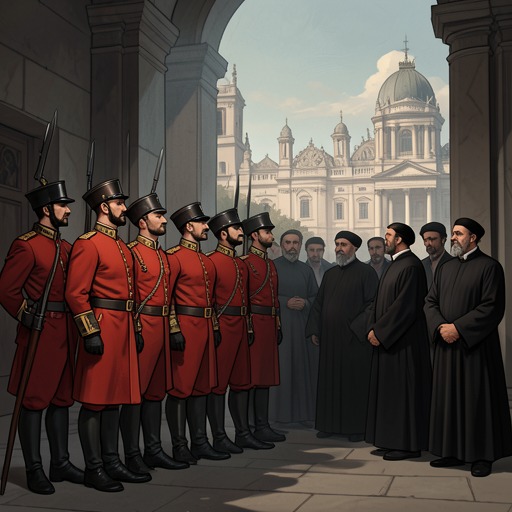
Yuan Shao and Cao Cao respond by storming the palace gates. In the ensuing disorder, four of the Ten Imperial Attendants are killed and the palace catches fire. Zhang Rang and Duan Gui escape with Emperor Shao and Prince Xie, but the struggle for control of the court has already become an open military emergency. He Jin’s death thus does not settle the conflict; it removes the official who initiated the summons while leaving the succession and the imperial family exposed to armed factions.
Political Significance
He Jin’s actions show how the court’s authority is entangled with family loyalty and military power. He has the formal standing to summon troops, but his judgment is shaped by his sister’s position as empress and by pressure from Yuan Shao. Cao Cao’s warnings and Lu Zhi’s later warning about Dong Zhuo both frame the danger of He Jin’s choices, yet the narrative shows him disregarding counsel at decisive moments.
The consequences reach beyond He Jin himself. His summons brings Dong Zhuo into the capital; his killing is followed by the palace assault, fire, and the flight of the young emperor and his brother. In the broader story of the Han’s decline, He Jin is therefore a pivotal but unsuccessful political actor: his attempt to break the eunuchs’ hold instead helps turn an internal court struggle into a crisis in which outside military power can dominate the throne.